
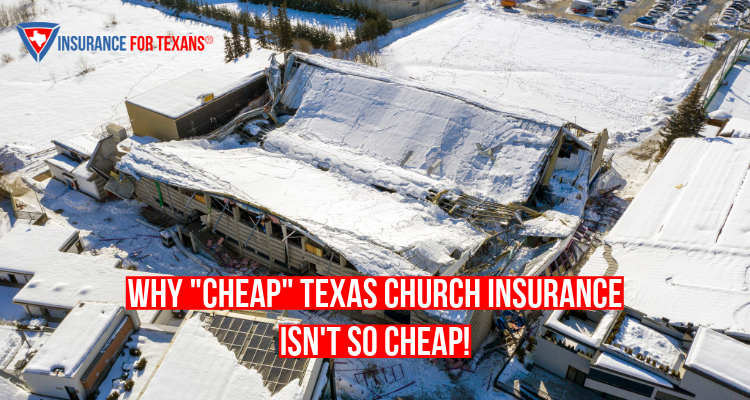
The pictures from Cedar Hill are heartbreaking.
Just weeks ago, Kingdom Culture Worship Center was a vibrant, growing church. The local church was an expansion from another state just a couple of years ago. They had done everything right and were hitting their stride.
When the recent forecast called for freezing temperatures, they kept the heat on. They dripped the faucets just like Texans are supposed to. They took every precaution a responsible property owner should take.
But they could not fight physics.
As the ice and snow accumulated on the roof during the winter storm, the weight became too much for the structure to bear. The roof of the sanctuary collapsed, crashing down onto the altar and destroying sound equipment, instruments, and the very heart of their worship space.
Fortunately, no one was inside when it happened. While we pray for Kingdom Culture Worship Center, this tragedy forces every other Pastor and finance committee member in Texas to ask a terrifying question.
If that happened to us, would we be covered by our church insurance policies?
You might assume the answer is yes. You pay your premium every month. You have property protection that your insurance agency put in front of you. You likely didn't ask a lot of questions about property damage and looked at the price. You just assume that if the building breaks, the insurance company pays to fix it.
But church insurance does not work that way. In the world of property insurance for churches, the "cause" of the damage matters more than the damage itself. And if you have purchased a cheap, "Basic" policy to save money on your premiums, you might be sitting on a ticking time bomb.
Gravity is not always covered.
Here are the three things you need to understand about your policy before the next big weather event hits.

1. The "List" vs. "Everything Else" Trap
When a church is looking for budget relief, many inexperienced insurance agents will offer a "Basic Named Peril" property insurance policy. These policies are significantly cheaper than standard coverage. They look great on a spreadsheet during a finance meeting.
But there is a reason they are cheap.
A Basic Named Peril policy only covers the specific list of disasters written on the paper. The items on this list are the only things your church building insurance policy will cover.
- Fire
- Lightning
- Windstorm or Hail
- Explosion
- Smoke
- Aircraft or Vehicle Damage
- Riot or Civil Commotion
- Vandalism
Notice what is not on this list? "Weight of Ice and Snow" is often missing from the Basic list. This is where a cheap church insurance policy can leave a church in a lurch.
If you have a Basic policy and your roof collapses under the weight of a winter storm, you are likely uninsured for that loss. The insurance company will point to the list, show you that it is not included, and deny the claim. You are effectively self-insuring against these other potential claims.
To be safe, you need a Special Form policy for property whether you are a small or large church. This flips the script. Instead of listing what is covered, a Special Form policy covers everything unless it is specifically excluded. In a Special Form policy, the weight of ice and snow is typically covered because it is not on the exclusion list.
2. "Collapse" is a Legal Description, Not Just a Description
You look at the photos from Cedar Hill and you see a roof on the floor. You call it a collapse.
But an insurance adjuster uses legal definitions rather than what you see. In an insurance policy, "Collapse" is a term with a very specific meaning.
Some policies may exclude "Collapse" as a primary cause of loss. They might add it back in as an "Additional Coverage," but they often restrict the definition severely when they do.
Some policies define collapse as the building falling completely to the ground and being reduced to rubble. If your roof bows, sags, or cracks dangerously but does not actually fall, some carriers will deny the claim. They will argue that the building has not "collapsed" yet, even if it is unsafe to enter.
Also, you have to check the triggers. The policy will say it covers collapse only if it is caused by specific things. You must verify that "weight of rain, ice, or snow" is listed as a covered trigger for collapse.
If your policy excludes collapse, or if it demands the building be flattened before it pays, you do not have the protection you think you have.
3. The "Wear and Tear" Escape Hatch
This is the nastiest argument in the insurance playbook, and we see it used on older church buildings in Texas when a weather natural disaster strikes.
Imagine your roof collapses under ice. You have the right policy form. You have coverage for collapse. You think you are safe.
The insurance company sends a structural engineer to inspect the rubble. The engineer pokes around the debris and finds some old water rot in the wooden trusses. He determines that this rot existed before the ice storm.
The insurance company can then deny your claim.
They will argue that the Proximate Cause of the collapse was not the ice. They will say the collapse was caused by "wear and tear," "deterioration," or "lack of maintenance" (the rot). Since every insurance policy excludes wear and tear, they deny the claim.
They essentially argue that the ice was just the final straw, but the real reason the building failed was because it was old.
This is a devastating tactic. It leaves churches with older buildings completely exposed.
To fight this, you need more than a generic agent who works only for a single big brand. You need an expert in Texas church insurance. An advocate who understands how to ask the hard questions up front so that you can be covered on the back end.
It is about more than some casual customer service. It is about knowing the difference in policy form types and how to get the liability coverage your church desperately needs to run the race that has been set before you.
The Promise of Certainty
The tragedy at Kingdom Culture Worship Center is a wake up call. It reminds us that our sanctuaries are fragile and that nature is unpredictable.
It also reminds us that "cheap" church insurance is often just a piece of paper. It looks like protection until you actually need it.
You cannot afford to wait for the next storm to find what your policy covers. You need to know today that your building, church-owned vehicles, and staff liability are all covered like you assume they are.
At Insurance For Texans, we don't just sell you a policy and hope for the best. We review your current Declarations Page to see if you are on a "Basic" or "Special" form. We identify the gaps that could leave your congregation homeless. That is what True Texas Church Insurance is all about.
We believe you deserve to know exactly what you are buying. We believe in The Promise of Certainty.
Don't leave your church's future to chance. Let us review your coverage so you can rest assured that if the unthinkable happens, you are ready.
Click the button to schedule your policy review so that you can have The Promise of Certainty before the next storm hits!