

TRIGGER WARNING: Although the opening story of this article is entirely fictional and used only to illustrate a point, it deals with the themes of gun violence, church violence and mass shootings.
Chuck glanced at his watch. Twenty seconds. That’s all it took for the church security team to neutralize the armed man who had burst into their place of worship on a Sunday morning. Twenty seconds of decisive, practiced action that stopped a nightmare in its tracks. A wave of relief washed over him. But it was immediately replaced by the cold, hard reality of their church's location in northwest San Antonio. He knew from their security team's drills that even with a priority call, the flashing lights of an ambulance navigating weekend traffic on Loop 1604 could be ten minutes away. Maybe more.
For a moment, the scene was frozen in time. There was the neutralized threat lying on the floor, the wide-eyed faces of the congregation, and the faint smell of gunpowder hanging in the air.
But Chuck’s church security team members didn’t freeze.
They had a plan that went beyond just stopping the bad guy. As two members kept their focus on the subdued attacker, the rest of the team fanned out. Their mission instantly shifted from security to triage.
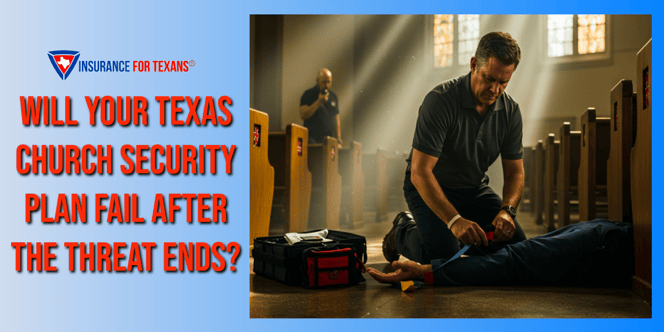
From pre-staged cabinets disguised as hymnal storage, they pulled out advanced trauma kits. One of Chuck’s men, a former Army medic, was already at the side of a wounded usher. His skillful hands were working with calm precision to apply a tourniquet to a leg injury. Another team member was applying pressure to a woman’s shoulder wound, speaking to her in a low, reassuring voice.
These mean and women were well trained members of the church's volunteer security services team. Not only did they each possess a license to carry a handgun, but they completed a Red Cross first responder training program.
Before the first siren was even a faint wail in the distance, Chuck’s team had applied tourniquets and pressure dressings that would end up saving three lives.

Why Do Most Church Security Plans Fail After the Threat Is Over?
Chuck’s story is a powerful testament to a job done right.
However, it also potentially highlights a terrifying gap in how most Texas churches approach security. There's a heavy focus on the "stop the threat" part of the equation, which is absolutely vital. But what about the immediate, chaotic aftermath?
Many well-intentioned volunteer security teams are prepared for the fight, but completely unprepared for what to do in the minutes after the gunfire is over. The time when a ten-minute EMS response feels like an eternity and the arrival of law enforcement creates a new, complex set of challenges.
This is where a security services plan transforms from a simple response into a comprehensive strategy that saves lives, protects places of worship from liability, and cares for the flock.
How Do You Integrate Medical Response Into a Security Plan?
Your church's security plan must assume that your team will be the first and only medical responders for a critical window of time. This is contrary to a plan that relies solely on calling 911. The latter is a gamble that could negate the volunteers' heroic actions of subduing the threat.
Integrating trauma medical training into your church's plan should be non-negotiable. We're not talking about the basic first-aid kit with band-aids and aspirin you have under the sink. We’re talking about training requirements for your team to learn how to deal with traumatic bleeding injuries. Programs like "Stop the Bleed" are specifically designed for laypeople and can be learned in a single afternoon. This training empowers volunteers to apply tourniquets, pack wounds, and manage pressure points. These actions are the most important factors for people to survive severe limb injuries.
Think back to Chuck's team in San Antonio. The reason they could act wasn't just courage, it was muscle memory built through training. They knew where the kits were because they had practiced retrieving them. They knew how to apply a tourniquet under pressure because they had done it on dummies, over and over. For a church, this means investing in not only the training but also the equipment. Having multiple, easily accessible trauma kits staged strategically throughout the building helps to save lives.
The grim reality is that in a mass casualty event, a person can bleed to death in as little as three to five minutes. EMS response times, especially in sprawling areas like San Antonio or Dallas-Fort Worth, can easily exceed that. Your security team's ability to bridge that gap with immediate trauma care is the difference between a list of victims and a list of survivors.
What Is the Protocol for When the Police Arrive?
When law enforcement arrives, your armed volunteers must instantly make it clear they are the good guys. There are no second chances to get this wrong.
This is one of the most dangerous moments for a volunteer security team. Responding officers are walking into a chaotic, high-stress situation. Their primary objective is to find and neutralize the threat. Anyone they see holding a weapon is, in their mind, a potential threat until proven otherwise. A tragic case of mistaken identity is a very real possibility, and it can undo all the good your team has done.
The protocol must be drilled into every single team member until it is an automatic reflex. The moment they hear sirens or are aware that police are on the scene, their weapons are holstered or slung, and their hands are empty and visible. Chuck's team had a pre-rehearsed script. The designated team lead, and only the team lead, would be the one to communicate.
He would slowly approach with empty hands held high, loudly identifying his team: "WE ARE THE CHURCH SECURITY TEAM. THE THREAT IS DOWN AND SECURED. WE ARE UNARMED."
Other members of Chuck's team knew to get on the floor or stand with hands visible, away from the neutralized attacker. They understood that their job was now to be compliant, quiet, and non-threatening witnesses. They had holstered their weapons immediately upon confirming police were entering the building.
This isn't a moment for ego or explanation. It's a moment for absolute, unquestioning obedience to a pre-planned procedure designed to keep everyone safe, including the officers. This coordination prevents a blue-on-blue tragedy and allows law enforcement to quickly secure the scene and begin their investigation.
How Do You Manage the Aftermath and Protect the Ministry?
After the immediate physical danger is over, the church faces two new threats: emotional trauma and legal liability. A good plan actively manages both from the very first minute.
While the medical and security teams are at work, the rest of the congregation is in a state of shock and panic. Part of a comprehensive plan involves caring for them. Chuck’s church had a designated team of ushers and staff, not part of the armed security detail, whose role was to move people to a secure, secondary location like a fellowship hall. They provided water, blankets, and a calming presence. They also had a plan for parent-child reunification, preventing a secondary wave of panic as parents scrambled to find their children. This act of shepherding the flock is a critical ministry function in a time of crisis.
Simultaneously, you must secure the scene for investigators. This means no one touches anything. The area where the incident occurred is now a crime scene. Roping it off and preventing anyone from entering or leaving preserves evidence and shows cooperation with law enforcement, which is imperative for the investigation and any subsequent legal proceedings. Chuck’s team had one member whose sole job was to stand at the sanctuary doors and ensure no one re-entered.
In the days and weeks that follow, the church leadership will face intense scrutiny. The decisions made by the security team will be analyzed, and the church's legal liability will be questioned. Having a well-documented plan, proof of training, and the right insurance coverage is your best defense.
This is where True Texas Church Insurance and USCCA become vital partners. A generic church insurance policy may not cover the actions of a volunteer security team, especially if they are armed. You need a specialist who understands the unique risks Texas churches face and can build a policy that provides liability protection for these specific scenarios.
How Can You Ensure Your Church Is Truly Ready?
Look at your security plan right now and evaluate how you will handle the moments after a threat is subdued.
1. Evaluate Your Medical Readiness: Do you have more than just a consumer first-aid kit? Have you invested in the Red Cross and Stop the Bleed training programs for your security team members? Are trauma kits staged and accessible?
2. Review Your Police Interaction Protocol: Is there a crystal-clear, drilled procedure for your team to follow when law enforcement arrives? Is it based on making officers feel safe and establishing that you are not a threat?
3. Assess Your Aftermath Plan: Do you have a plan to care for the congregation, secure the crime scene, and manage communications?
True Texas Church Insurance
Thinking through these scenarios is daunting. It’s heavy stuff, and it feels a world away from the Sunday morning message. But as a preacher's kid from the Panhandle, I can tell you that being a good steward means protecting your church's people and mission with wisdom and clarity.
Your security team's bravery is not in question. But bravery without a complete plan can lead to tragic consequences. You don't have to figure this out alone. The team here at Insurance For Texans has worked with hundreds of churches across the state to navigate these exact issues.
Don't wait for a crisis to discover what's missing from your plan. Let's talk.
Click the button below to start a conversation with our True Texas Church insurance agents today.