
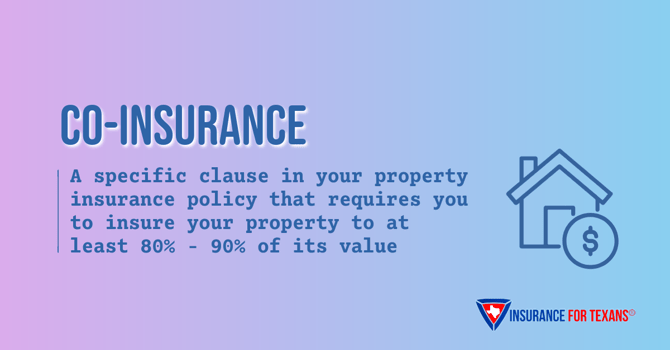
If you choose a coverage limit lower than this requirement, the insurance company will penalize your claim payout. Co-insurance applies to both homeowner's insurance and commercial insurance.
An Expensive Mistake
Mark owns a successful machine shop in Midland. His building is worth $1 million, but to save a few bucks on his monthly premiums, he only insured it for $500,000. He figured that since he’d likely never have a total loss, $500k was plenty of cushion. When a small electrical fire caused $100,000 in damage, Mark expected a check for the full amount. Instead, because he failed the 80% co-insurance requirement in his policy, the insurance company applied a penalty. They only sent him $62,500. Mark had to find $37,500 of his own money to fix his building.
The Silent Clause in Texas Property
Mark’s situation is a nightmare that can stay hidden until the worst possible moment. In Texas, where property values are increasing faster than a West Texas windstorm, many business owners and homeowners are falling out of compliance with their co-insurance clauses without realizing it. If your building's value has gone up but your insurance limit stays the same, you are dangerously under-insured.
The insurance company expects you to be a partner in the risk. Make sure that you review your property insurance renewal each year before signing on the dotted line.
How Co-insurance Actually Works
Think of co-insurance as a fair share agreement. The insurance company gives you a rate based on the idea that you are paying to insure the property for what it's actually worth.
The math they use during a claim looks like this:
- The Requirement: You must insure for at least 80% (or 90%) of the replacement value.
- The Check: If you are under-insured, they divide what you did carry by what you should have carried.
- The Penalty: That fraction is then applied to your claim.
(Amount Carried / Amount Required) x Loss = Your Payout
Why It’s a Growing Risk in Texas
This is a major issue in growing markets like DFW, Austin, and Houston. As the cost of labor and building materials like lumber and steel goes up, the replacement cost of your building rises too. If you haven't adjusted your policy limits in the last two or three years, you might unknowingly be in violation of your co-insurance clause. You are essentially self-insuring a portion of every single claim without getting the benefit of a lower rate.
Stop Gambling with Your Payout
Co-insurance isn't meant to be a punishment, but it certainly feels like one when you’re staring at a $40,000 shortfall. The only way to avoid the penalty is to ensure your policy limits accurately reflect the real-world cost to rebuild your property today.
Are you meeting your co-insurance requirement? Most people don't find out they've failed the co-insurance test until the adjuster does the math. Our personalized risk assessment takes the guesswork out of your valuation, ensuring your limits are high enough to trigger a full payout when you need it most.